Visit-based EHR
Rich at the encounter, empty between them. Hard to see nocturnal clustering, rescue use, or caregiver burden.
Pharma & research partners
Epilog is a privacy-first diary used by people living with epilepsy and the caregivers who log for them. With research sharing on, we produce coded weekly snapshots — seizure patterns, ASM mix, mood, and age band — that partners receive only as aggregates.
Why this conversation
Most epilepsy “real-world data” is sparse EHR, claims, or paper diaries. The clinically useful interval is daily life: events, rescue, ASMs, and mood as they happen — including children logged by a parent.
Rich at the encounter, empty between them. Hard to see nocturnal clustering, rescue use, or caregiver burden.
Unstructured, incomplete, and rarely coded. Side effects and time-of-day are lost in free text.
Coded logging at the moment of care: type, duration, severity, rescue, Watch vs phone, ASM mix, mood scales, age band.
Product
Built by LND Tech after lived experience with paediatric epilepsy. Clinical records stay on device unless the person opts into a feature — research sharing, encrypted Pro sync, or share-with-doctor.
One-tap timer, 11 recognised types, severity, duration, triggers, recovery, Watch capture.
ASM tracking, frequency, dose, predefined side effects, currently taking vs stopped.
Tags, 1–5 scales for stress, anxiety, energy, sleep, and an elevated-risk mood flag.
On-device doctor reports and optional live summaries — a separate product from research data.
Doctors buy time and signal quality in clinic. Research partners buy population signal. We do not mix the two datasets.
The wedge
A small EU company cannot out-scale a claims warehouse. We can be the partner who will never hand over a re-identifiable file.
Anonymous research sharing is on at first use unless turned off (GDPR Art. 6(1)(a) consent). For a named pharma or academic study we add a second, explicit opt-in — IRBs typically will not accept default-on as study consent.
Recipients: Google Firebase (processor) and LND Tech. Aggregated, non-identifiable datasets may be shared with healthcare research partners only.
Schema v6 snapshot
Same coded fields the privacy policy lists. Month-year only — never clock time, GPS, notes, or identity.
Hard exclusions
Evidence questions
| Partner question | What Epilog can show |
|---|---|
| Which ASMs are people logging? | Medication mix, currently-taking %, approximate duration on therapy, age-band slice |
| What side effects show up in the wild? | Predefined side-effect frequencies, cut by drug name / category / age band |
| When do events cluster? | Time-of-day buckets and month-year — not clock time |
| How severe or long are events? | Severity 1–5 and duration buckets (<30s through 5m+) |
| Rescue use in the community? | Share of seizures with rescue marked as taken |
| Paediatric vs adult patterns? | Age bands including caregiver-logged Child profiles |
| Wearable capture? | % of seizures flagged as Apple Watch recordings |
| Geography? | Coarse region mix plus GPS / geocode coverage quality |
Methodology
Each opted-in device uploads a full snapshot about once a week. The same seizure or ASM row can appear again. Use percentages and per-snapshot averages, not pooled totals as unique events.
By design there is no way to follow one person. That is a privacy feature. It rules out individual trajectories; it still supports population mix and sliced distributions.
Medication strings are user-entered. Mapping to ATC / RxNorm is a paid deliverable. Free-text “Other” is excluded on purpose.
Coverage gaps (unknown age, no GPS, missing triggers) stay in the dashboard. We treat missingness as a finding, not something to hide. Small cells are suppressed (k-anonymity) before a partner ever sees a cut.
Commercial packages
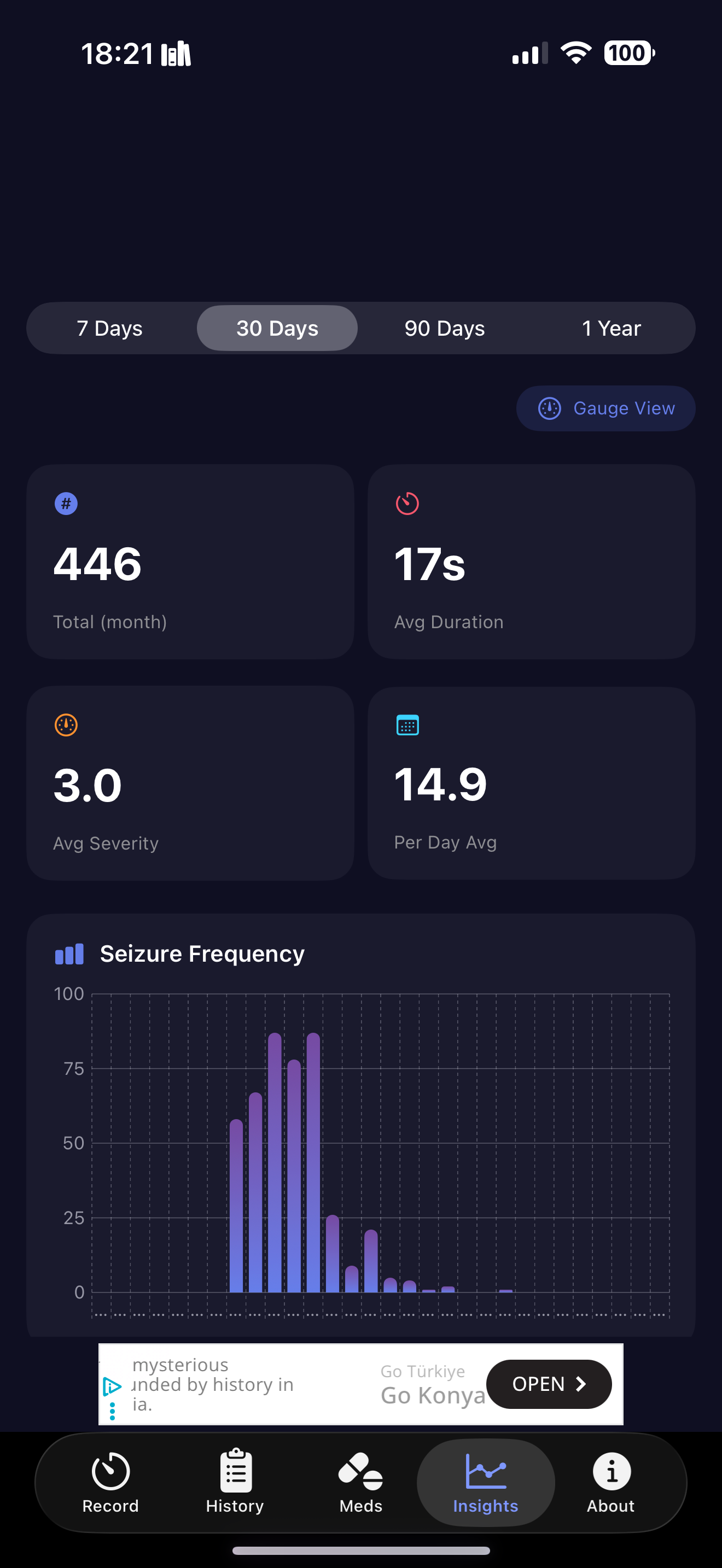
Quarterly aggregate dashboard: ASM mix, seizure type, time-of-day, rescue, Watch share, age bands, side effects. Fastest path. Sample of the same views our research admin already produces.
A defined slice — e.g. focal seizures, age 0–17, one region or ASM class — delivered as k-anonymous tables. Cells below threshold are dropped.
You fund a protocol. We add optional in-app questions behind a named, explicit opt-in. You never receive UIDs. Best fit for observational / RWE programs.
Guardrails
| Step | What happens |
|---|---|
| 1. Scope | Written questions, population, geography, and whether we need a study-specific opt-in |
| 2. Paper | DPA, purpose limitation, no re-identification, no onward sale, EU-friendly processing terms |
| 3. Ethics | Your IRB / ethics path. We will not claim default-on app sharing as protocol consent |
| 4. Delivery | Aggregates or k-anonymous tables. Optional live dashboard. No raw snapshot JSON as the default |
| 5. Review | You see methodology notes (repeat bias, missingness) in the same pack as the charts |
Stage honesty
We will not sell this as a finished claims-scale RWE asset. We will sell a working consent path, a locked schema, and a dashboard that already folds snapshots into the questions on the previous slides.
Now — pilot insights, proof of instrument.
Hundreds of weekly opt-ins — recurring aggregate dashboard.
Thousands + optional modules — prospective observational add-ons, still aggregate and protocol-bound.
LND Tech · Epilog
A first call should leave with a draft question list, whether you need a study opt-in, and whether the first deliverable is a brief, a custom cut, or a protocol.
Leandro Barreto · LND Tech